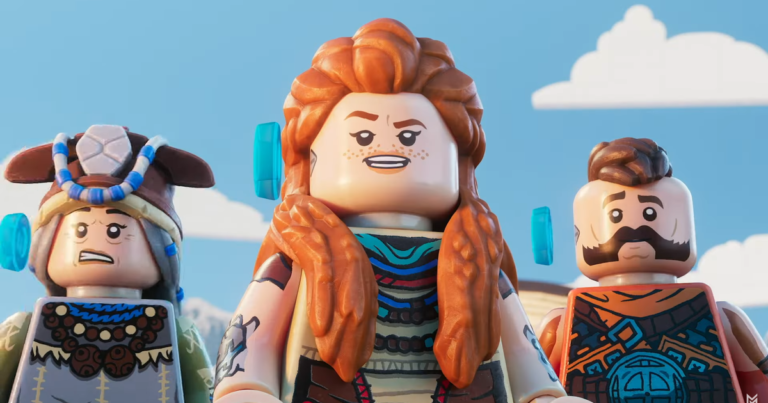

The Legos, as I fondly called them, were my absolute favorite childhood toys. From the larger pieces perfect for small hands to the smaller ones more suited for larger hands and fingers, I was hooked. Flipping through catalogs filled with boxes and constructions for all ages, I dreamed of bringing houses, castles, police stations, and more to life. I was lucky enough to receive some of these sets and would meticulously construct them, keeping the boxes and instructions for future builds. I even created my own city on a big table, complete with an airport, a villa, and even a small castle.
Living the Lego Life
During vacations, I spent hours moving pieces and figures around, flying planes, and adding some medieval knight action to the mix. It was like playing the first open-world game without even knowing it. And now, as I look at the latest Lego sets, I can’t help but imagine how they would fit in with my existing creations.
Lego 2K Drive: A New Adventure
Lego 2K Drive, developed by Visual Concepts, is a departure from the usual Traveller’s Tales Lego games. This open-world racing game brings a new narrative, characters, and high-speed missions to the table. While it may lack licensed characters, it makes up for it with its own unique charm and a diverse range of challenges across different terrains.
The Transformation of Vehicles
One of the standout features of Lego 2K Drive is the automatic transformation of vehicles to suit various surfaces. From land to water, asphalt to dirt paths, your vehicle seamlessly adapts to the environment. It’s like playing Mario Kart meets Forza Horizon, with a touch of Sonic & All-Stars Racing Transformed thrown in for good measure. The gameplay is easy to pick up, with simple techniques like drifts and braking to master. However, the game’s moderate difficulty level ensures that players of all skill levels can enjoy the thrill of the race. And don’t be surprised if you encounter some cheeky AI opponents trying to steal your victory at the last minute!
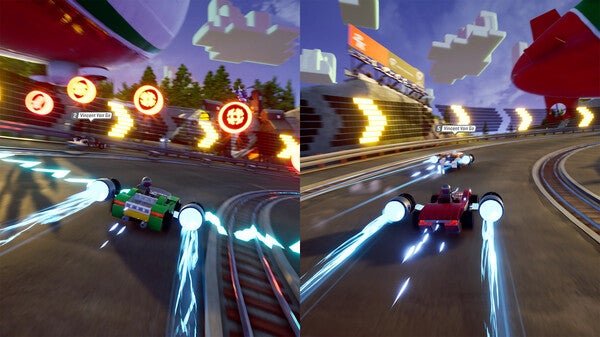
Physics is interesting, with consistent vehicle behaviors even when driving vehicles with more or less weight. It’s as if the gameplay is standardized around three categories, with only a few vehicle adjustments changing from vehicle to vehicle. In practice, this makes driving more similar.
Territories like theme parks
Bricklandia is the designation of the area that encompasses various territories, especially Turbo Acre’s, the first major area, the Big Butte County desert, and the famous waterfalls of Prospecto Valley. Instead of a large interconnected world map, the producers opted to create distinct zones and maps, linked to a certain theme. Without the dispersion that tends to be natural when creating a vast territory, it is easier to concentrate challenges and reach mission points without having to cross large sections behind the wheel.
With sections closer together, challenges and races are nearby. The checklist is marked on the map, and a marker can be added for easier access. It’s a shame that the production of these various territories and maps doesn’t stand out. Even with smaller areas, there are large uninhabited portions, somewhat generic and minimalist with little to interact with, resulting in many desolate sections with just a few characters to run over, uh… interact with.

There is freedom in choosing missions, ranging from Mario Kart-style races to small courses in which the goal is to set a good time while avoiding bombs placed on the ground. There is a great disparity in objectives and unusual situations. The goal is to level up, gaining more experience points, and thus facing more powerful rivals, in a plot that, far from seducing with the quality of the argument, serves the sense of discovery of Bricklandia.
Corner garage
The car garage is more than just a meeting point. In addition to allowing quick transitions between territories, it is the place to carry out all kinds of constructions and modifications to existing vehicles. The idea is to build cars and take them to the tracks, taking advantage of some benefit and attribute. The creation and modification process is not very complicated. It requires a break from the chaotic experience of races and missions. A somewhat “zen” and fun moment as the pieces are put together.
Acquiring vehicles can be especially costly. Money (brickbucks) is earned by completing missions, useful for some parts but buying a new car is even more expensive. It’s a shame that the creation process is limited by this conditioning and way of slowing down progress, forcing a repetition of missions and even some parsimony in the acquisition of new parts, just so that advances and real improvements to the cars are reflected with more time spent playing. Spending real money to buy these cars is also not the best solution.
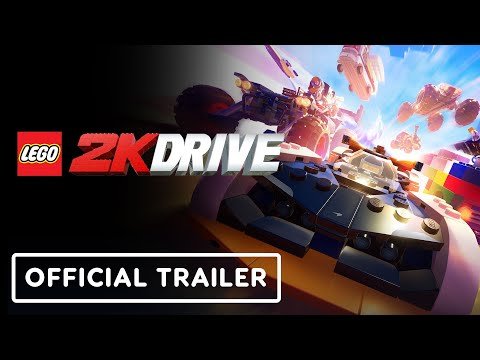
Watch on Youtube
With racing trophies, mini-games, and access to online races, the content is far from lacking. But it’s the saturation effect, derived from the accessibility or ease with which missions are completed, and other times by their rudimentary nature that make the experience less remarkable. Constantly wandering back and forth, it’s in the construction moments that a car to taste is produced. If other games from this toy brand left good memories after putting down the controller, this driving title, although interesting, is not particularly outstanding in any area. It works well and can reach a wide audience, but the time spent on the road is quickly forgotten, leveling up.
- Driving
- Vehicle construction
- Constant humor
- Rich in content
Vehicle construction, constant humor, and rich content are key elements of this new show. But it also comes with its own set of drawbacks.
Pros and Cons
- No major challenges
- Too accessible
- Investment in vehicle construction
- Large portions of empty territories
Despite its flaws, the show manages to keep viewers entertained with its unique mix of humor and informative content. Whether you’re a fan of vehicles or just looking for a good laugh, this show has something for everyone.
About the Author